
Governance
In Atlas Amazon, governance refers to the structures, actors, and processes through which areas are managed — the institutional framework within which stewardship happens. Where stewardship describes how an area is cared for in practice, governance describes the system that enables, guides, or constrains that care.
Why Governance Matters
What happens in an area depends less on whether it has been designated than on how it is governed. Differences in governance feed directly into ecological integrity, patterns of resource use and management, equity and rights, and long-term sustainability.
Across the Amazon these systems are diverse and frequently overlapping, so understanding that diversity is a prerequisite for interpreting stewardship outcomes at all.
What Governance Includes
Governance is made up of three interacting dimensions:
- Actors — the individuals, communities, institutions, and organizations involved in decision-making and management
- Rules and authority — the formal and informal rules defining rights, responsibilities, and decision-making authority
- Decision-making — the processes through which decisions are made, implemented, and enforced
Governance Types
Broadly, governance arrangements fall into four types.
State governance
Managed primarily by government institutions, typically within protected areas.
Collective governance
Governed by Indigenous peoples or local communities through customary or legally recognized systems.
Private governance
Managed by private actors, including reserves, concessions, or certified lands.
Shared governance
Co-management arrangements involving multiple actors and institutions.
In practice, many areas combine elements of more than one type, which is why the Atlas records governance type and subtype separately.
Governance in the Atlas
Governance is a core attribute of every area, recorded as structured information on governance type and subtype, the actors involved, where authority and management responsibility sit, and how those actors relate to one another. Linking this to areas and assessments is what makes it possible to analyze how governance arrangements relate to stewardship and outcomes. The full field list is documented under Governance metadata.
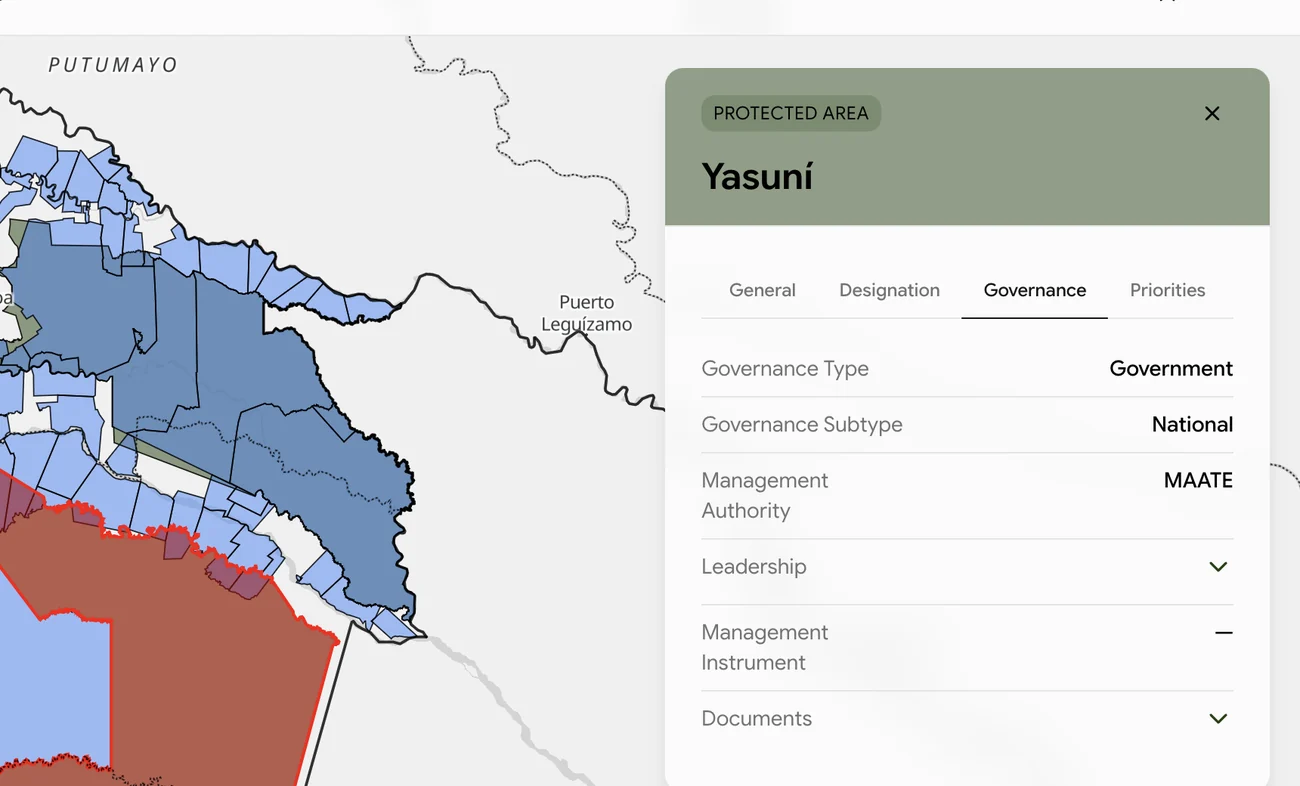 Governance type, subtype, and management authority for Yasuní, with leadership and documents collapsed
Recognizing Diverse Systems
Conservation data systems have historically centered on state-managed protected areas. Across the Amazon, though, a much broader range of governance systems does the work — Indigenous territories, community-managed lands, co-managed landscapes, and hybrid arrangements that are still taking shape.
The Atlas documents governance across that full spectrum rather than only the part of it that fits conventional reporting.
In Practice
Governance is not static: institutions change, policies shift, actors reorganize, and conflicts emerge or get resolved. Documenting governance alongside stewardship and designation is what lets the Atlas represent conservation systems as the moving targets they are.