
Designation
In Atlas Amazon, designation refers to the legal, policy-based, or customary status of an area — how it is categorized, recognized, and often regulated within national or international systems. It matters because designation shapes governance authority, rights, and the institutional context in which stewardship takes place.
What Designation Represents
Designation captures how an area is recognized in practice, which can happen through several routes: legal designation under national law (protected areas, Indigenous territories), recognition through policy instruments or conservation frameworks such as OECMs, or customary and collective recognition of territories.
These forms of recognition differ widely across governance systems, but all of them influence how an area is governed and managed.
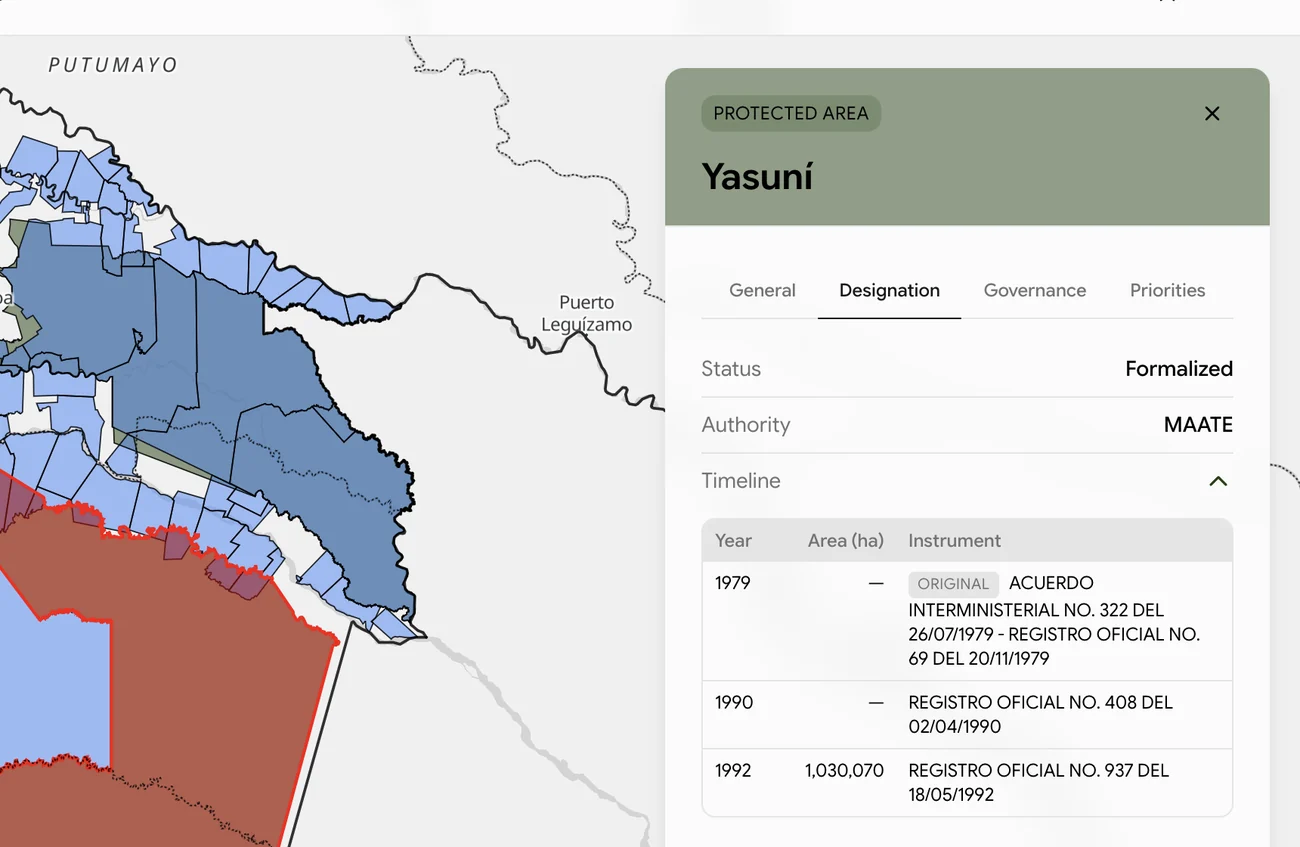 Designation status and authority for Yasuní, with its timeline of instruments expanded
Why It Matters
Designation shapes four aspects of a conservation system at once.
| Dimension | Role |
|---|---|
| Governance authority | Determines who has the right to make decisions |
| Rights and tenure | Defines recognition of land and resource rights |
| Management objectives | Influences how areas are intended to function |
| Access to support | Affects eligibility for funding and policy mechanisms |
Because it touches all four, designation is essential for understanding why stewardship systems and their outcomes differ.
Challenges
Designation systems vary widely across the Amazon, which limits comparability in several specific ways.
| Challenge | Description |
|---|---|
| Diverse classifications | Countries use different categories and legal definitions |
| Inconsistent terminology | Similar areas may be labeled differently across contexts |
| Delays in recognition | New designations may take years to appear in datasets |
| Overlapping designations | Multiple or contested designations may apply to the same area |
Atlas Approach
The Atlas standardizes designation data without flattening local specificity. Each area carries structured fields covering its area classification (such as Protected Area or Indigenous Territory), its specific country-level designation type, the designation year, the authority and legal instrument behind the designation, and any designation conflict such as overlap or dispute.
This allows consistent comparison while keeping each record traceable back to the original system. The full field list is documented under Designation metadata.
Designation Status
To make designation comparable across contexts, the Atlas records how far recognition has advanced using a controlled vocabulary, from which a standardized 1–5 progression scale is derived.
No process
No formal designation, recognition, titling, demarcation, or official proposal process has been identified.
Proposed
A formal request, claim, application, or proposal has been submitted or documented, but has not substantially advanced.
In process
The area is undergoing technical studies, legal or administrative review, consultation, objection, or validation.
Partly formalized
The area has some official recognition, declaration, demarcation, or provisional status, but the process is not fully complete.
Formalized
The main legal act of designation, recognition, establishment, titling, or registration has been completed.
Where available information is insufficient or unreported, status is recorded as Unknown and carries no scale value.
Limits of Designation
Designation is essential, but it does not describe how an area actually functions. Legal recognition is no guarantee of effective management, a formal designation may not reflect governance as it is practiced, and some stewardship systems operate with no formal recognition at all.
For that reason, designation has to be read alongside governance and stewardship. It is one of three core dimensions in the Atlas:
- Area — where a system exists
- Designation — how it is recognized
- Stewardship — how it is governed and managed
Taken together, these give a fuller account of a conservation system than any one of them can on its own.